
Short answer
Vanilla fragrance oil is a sweet, creamy, warm scent built to smell like vanilla, usually from vanillin plus supporting materials, sometimes with natural vanilla extract or absolute. It is a base note that adds warmth, softness and staying power to candles, diffusers, sprays and perfume oils. Types differ in sweetness, smokiness, creaminess and color, so brands should approve a sample in their own product.
Key Takeaways
- Vanilla fragrance oils range from clean, sugary vanillin styles to dark, boozy, smoky or woody vanilla.
- Natural vanilla gets its aroma from curing, where the precursor glucovanillin is hydrolyzed to vanillin; most fragrance oils reconstruct vanilla rather than use only the bean.
- Vanilla is a base note that smooths and anchors other scents, which is why it appears in so many blends.
- Color, discoloration and performance in your wax or base are the usual vanilla pitfalls, so test before you launch.
- Ask for the safety data sheet and IFRA documentation for the specific fragrance and batch.
What is vanilla fragrance oil?
Vanilla fragrance oil is a concentrated scent oil that recreates the smell of vanilla for use in products such as candles, diffusers, room sprays and perfume oils. It is a composed fragrance, not a single raw material, and it is different from vanilla extract used in food.
Most vanilla oils combine three layers:
- A vanilla core: vanillin or related materials give the familiar sweet, creamy smell.
- Supporting notes: musk, amber, tonka, woods, resins or spices add depth and stop the scent from smelling flat.
- Optional natural material: some formulas use natural vanilla extract or absolute for a richer, less linear result.
For a guide to the oil category in general, see our home fragrance oils and candle fragrance oils ranges.
What does vanilla smell like?
Vanilla smells sweet, creamy and warm, with a soft balsamic roundness. Depending on the formula it can also read as boozy, smoky, woody, powdery or milky.
The main facets of a vanilla scent are:
- Sweet: the sugary, bakery side most people expect.
- Creamy: a soft, milky smoothness that rounds off sharper notes.
- Warm and balsamic: a resinous, comforting depth.
- Boozy or smoky: darker facets, stronger in natural-style or “bourbon” vanillas.
- Woody or powdery: a drier finish, common in tonka and sandalwood blends.
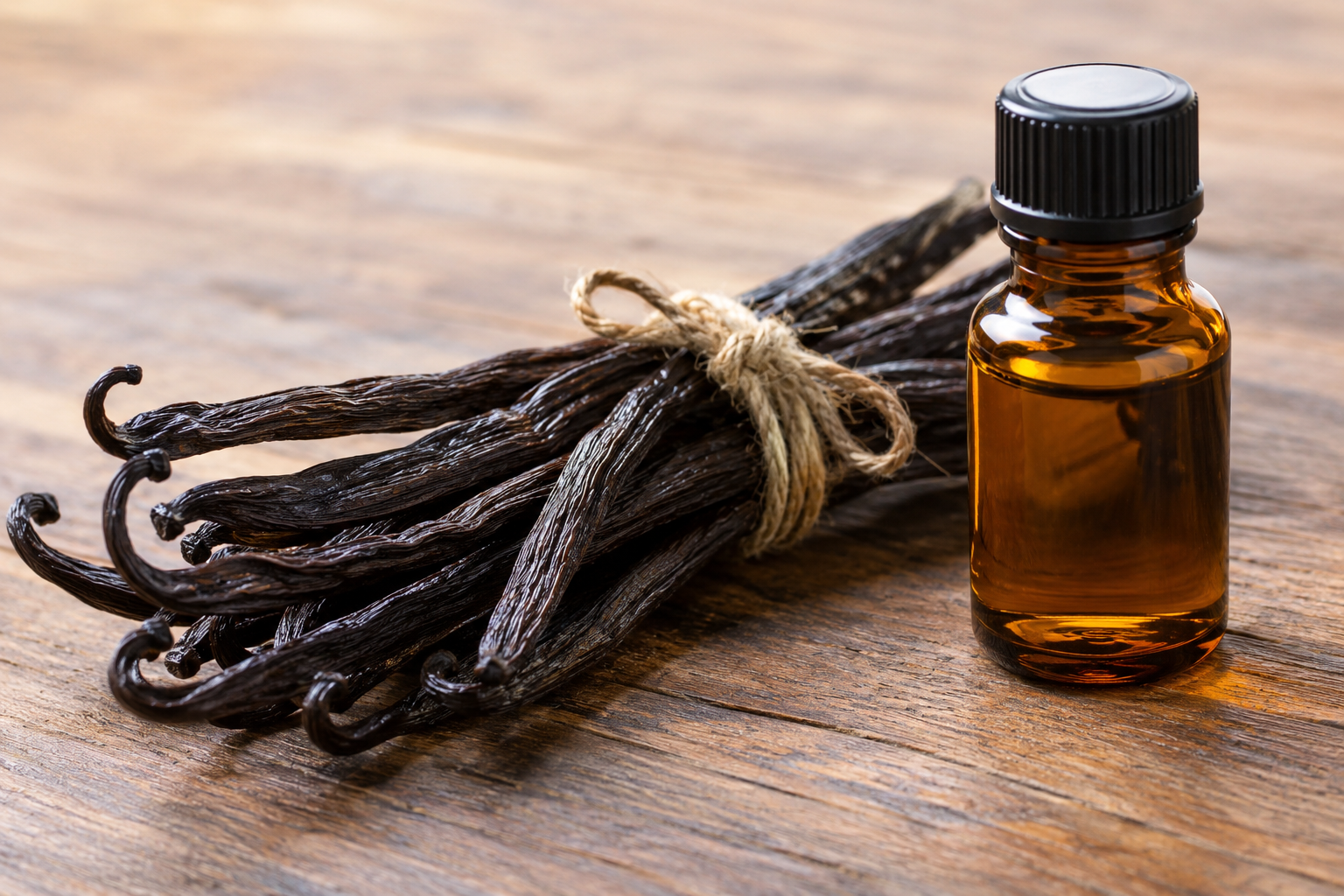
Where does the vanilla smell come from?
The vanilla smell comes from vanillin, which forms when the bean is cured. A 2015 study in Applied and Environmental Microbiology reports that glucovanillin in Vanilla planifolia beans is hydrolyzed by β-D-glucosidase during curing, and that colonizing Bacillus microorganisms are involved in that step.
Curing is not fully efficient. A 2018 study of enzymatic treatment of green vanilla beans found glucovanillin still present in commercial and traditional extracts, which the authors take as incomplete hydrolysis during curing. Their enzyme-assisted method released 82.57% of the vanillin theoretically available from its precursor.
The practical point for buyers is simple: the bean needs a long, handled process to develop its aroma, which is one reason natural vanilla materials are costly and variable. The sources above describe the chemistry only, so ask a supplier for current prices rather than assuming a figure.
Natural vanilla vs vanillin: which is in the oil?
Most vanilla fragrance oils use vanillin or related materials as the base, and some add natural vanilla for depth. Neither choice is automatically better; they give different results and cost different amounts.
| Approach | Typical scent | Typical use | Watch for |
|---|---|---|---|
| Vanillin-based accord | Clean, sweet, creamy, linear | Candles, diffusers, room sprays | Can smell flat or sugary if not supported with other notes |
| Vanillin plus supporting notes | Rounder, warmer, more complex | Most commercial vanilla scents | Behavior depends on the supporting materials |
| With natural vanilla extract or absolute | Deeper, darker, sometimes smoky or boozy | Premium and perfume-oil styles | Higher cost, batch variation and dark color |
The scent descriptions above are general perfumery vocabulary, not measurements. If a product claims “natural vanilla”, ask exactly which material is in the formula before you repeat that claim.
What types of vanilla fragrance oil are there?
Vanilla fragrance oils are usually sold by style rather than by a fixed standard, so the same name can mean different things at different suppliers. The labels below are common in the trade, but treat them as scent directions and confirm with a sample.
- Classic or pure vanilla: a clean, sweet, creamy vanilla with little else going on.
- Bourbon or bean-style vanilla: darker and richer, often with boozy, smoky or balsamic facets.
- French or custard vanilla: creamy and dessert-like, closer to custard or ice cream.
- Vanilla with woods or tonka: drier and warmer, with a powdery or almond-like finish.
- Vanilla with florals or fruit: a lighter, brighter vanilla for everyday home scents.
- Vanilla with spice or musk: a cozy, skin-like vanilla for fall and winter ranges.
The note is also a close relative of tonka and amber. See our guides to tonka and amber fragrance oil if you are choosing between warm base notes.
How does vanilla behave in a blend?
Vanilla behaves as a base note: it lasts, softens sharp edges and holds lighter notes in place. That is why perfumers and candle makers add it to florals, fruits, woods and spices.
| Partner family | What vanilla adds | Product direction |
|---|---|---|
| Amber, musk, sandalwood | Warmth and a skin-like softness | Perfume oils, premium candles |
| Woods, patchouli, tonka | A creamy balance to dry, dark notes | Cozy candles, hotel-style scents |
| Jasmine, tuberose, orange blossom | Creamy depth under white florals | Floral-gourmand blends |
| Citrus, fresh fruit | A soft base under bright, short-lived tops | Room sprays, light diffusers |
| Cinnamon, clove, cardamom | A rounder spice edge | Seasonal and winter ranges |
For related notes, see our guides to patchouli, jasmine and cashmere. Our gourmand fragrance oils page covers the wider dessert-style family.
Where is vanilla fragrance oil used?
Vanilla fragrance oil is used in candles, wax melts, diffusers, room sprays, perfume oils and car scents, and each format changes how it performs. The same oil can smell different in wax than in a diffuser base.
- Candles and wax melts: vanilla is a popular base for cozy, long-lasting scents. See our top fragrance oils for candle making for how scents are chosen.
- Diffusers: creamy vanilla needs a compatible carrier; check our diffuser carrier guide.
- Room sprays: sweet vanilla can feel heavy in a fine mist, so test the dose.
- Perfume oils: richer, darker vanillas suit skin-contact formats; see perfume oils.

What should brands and buyers check?
Check six things before you put a vanilla scent in a range: color, scent strength in your base, stability, documents, claims and minimum order.
- Color and discoloration: vanilla oils are often tinted and can change a pale wax or base. Ask for the oil’s color and test a finished sample over time.
- Performance in your base: check cold and hot scent throw in your own wax, diffuser base or spray. Our guide on weak candle scent lists common causes.
- Flash point and safety: read the flash point and handling data for candle use; see our flash point guide.
- Documents: request the safety data sheet and IFRA documentation for the specific fragrance and batch. Our IFRA compliance guide explains what to ask for.
- Claims: do not call a product “natural vanilla” or “vanilla bean” unless the supplier can state what is in the formula.
- Quantity: confirm the minimum order for the service you are buying, not a headline figure.
How does CQ Fragrance approach this?
CQ Fragrance (Dongguan Chengquan Fragrance Technology Co., Ltd.) is a fragrance oil manufacturer that lists custom fragrance development, fragrance duplication, OEM/ODM production, private label and wholesale supply. Its site lists Gourmand among its fragrance families and describes oils for candles, diffusers, car and home use.
- Brief to sample: a brand brings a vanilla concept or reference, and the scent is sampled and adjusted before production. See custom fragrance development.
- Library: CQ Fragrance describes a library of production-tested formulas.
- Verification: the site says components are checked by GC-MS and formula records support batch consistency.
- Documents: the site lists IFRA-related documentation, MSDS and export documents. Buyers should still ask for the documents for the specific fragrance and batch.
- Minimums depend on the service: its OEM/ODM page lists production from 1 kg per fragrance, its wholesale page lists bulk supply from 100 L per fragrance, and its private label page lists finished products from 500 units per SKU. Confirm terms per project.
The site also says one scent can often be adapted across candles, diffusers and sprays, with performance testing in each format.
Developing a vanilla scent for your range?
Share your scent brief and product format, and CQ Fragrance can help with custom development, OEM/ODM production or private label sampling.
Request a quoteFrequently Asked Questions
What is vanilla fragrance oil?
Vanilla fragrance oil is a concentrated scent oil that recreates the smell of vanilla for candles, diffusers, sprays and perfume oils. It is usually built from vanillin and supporting notes, and it is not the same as food-grade vanilla extract.
Is vanilla fragrance oil natural?
Vanilla fragrance oil may be natural, synthetic or a blend, and the name alone does not tell you which. Ask the supplier what is in the formula before you make any natural claim.
Why does vanilla fragrance oil turn brown?
Vanilla fragrance oil is often brown because many formulas are tinted or contain materials that darken, and some can change the color of a pale wax or base. Test a finished sample over time and ask the supplier about color stability.
Is vanilla a base note?
Vanilla is a base note because it is warm, long-lasting and supports lighter notes above it. In candles and perfume oils it is often the anchor of the blend.
What scents blend well with vanilla?
Vanilla blends well with amber, musk, sandalwood, patchouli, tonka, florals, citrus and warm spices. The partner decides whether the result smells cozy, fresh, powdery or dessert-like.
Bottom line
Vanilla fragrance oil is a warm, sweet, creamy base note that comes in many styles, from clean vanillin to dark, boozy vanilla. It is easy to like but easy to get wrong in color and performance. Ask what is in the formula, test it in your own base, and request documents for the exact fragrance and batch.