
Short answer
Neroli smells bright, floral and lightly citrusy, with a green, dewy opening and a honeyed, faintly spicy heart. It is cleaner and fresher than most white florals, and sometimes slightly soapy. It comes from the blossoms of the bitter orange tree. Perfumers use it to link citrus openings to richer florals, woods and musks.
Key Takeaways
- Neroli is a floral-citrus note with green, honeyed and clean facets; it is lighter than jasmine or tuberose.
- Neroli, orange blossom absolute and petitgrain all come from the bitter orange tree but from different parts and processes.
- Published analyses show neroli oil is dominated by linalool, limonene and related terpenes, and the balance varies by sample.
- Because the profile varies, brands should approve neroli on a sample and request documents for the exact fragrance and batch.
- Neroli works as a bridge note in candles, diffusers and perfume oils, but each format needs its own performance test.
What does neroli smell like?
Neroli smells fresh, floral and citrusy, like orange blossom with the heaviness removed. It opens bright and green, then settles into a soft, honeyed floral.
The main facets of neroli are:
- Floral: a light, delicate white-flower core that feels clean rather than heady.
- Citrusy: a gentle bitter-orange brightness, more floral than a fruit peel.
- Green: a dewy, leafy lift in the opening.
- Honeyed: a soft sweetness that appears as the scent warms up.
- Clean or soapy: a bright, washed feel that some people read as soap.
Neroli is usually subtle rather than projecting. That is why it is popular in light, unisex and warm-weather scents.
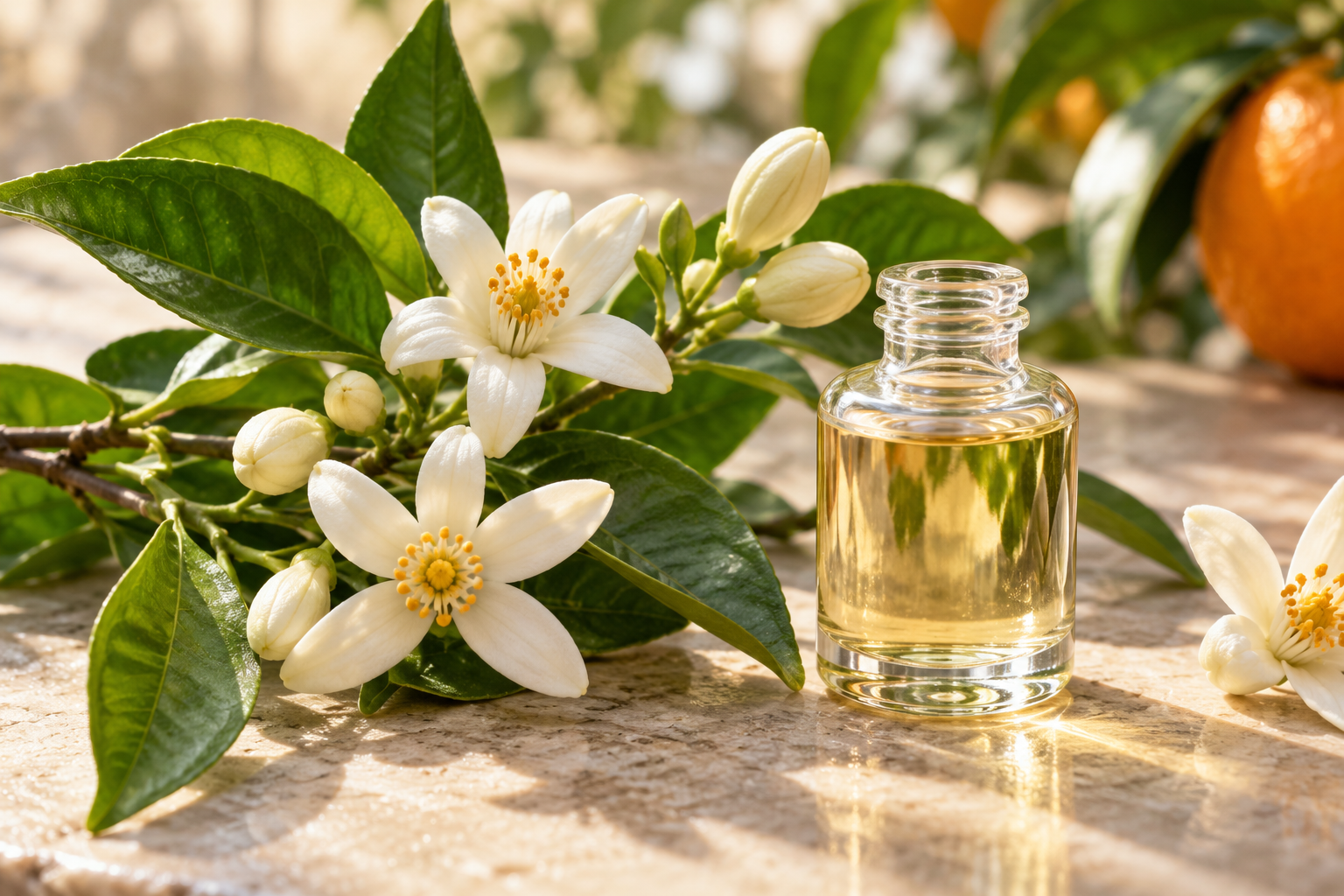
What is neroli, and how is it made?
Neroli is the essential oil of bitter orange (Citrus aurantium) blossoms, made by distillation. A 2019 review in Frontiers in Plant Science treats neroli as the flower oil of citrus and describes steam distillation as the basis for extracting essential oils from citrus flowers, leaves and peel.
The yield is small. In a 2013 study in Molecules of bitter orange grown in Greece, flowers hydrodistilled for 3 hours gave 0.12% oil (mL per 100 g of fresh flowers). That low yield is one reason natural neroli is costly.
The name is usually traced to a 17th-century Italian princess associated with Nerola, who is said to have favored the scent. Treat that as perfume folklore rather than a documented fact.
Neroli vs orange blossom absolute vs petitgrain: what is the difference?
Neroli, orange blossom absolute and petitgrain all come from the bitter orange tree, but they differ by plant part and by extraction method. The 2019 review defines petitgrain as the essential oil of citrus leaves and small branches, and notes that solvent extracts are not true essential oils under the European Pharmacopoeia.
| Material | Plant part | Process | Typical scent |
|---|---|---|---|
| Neroli | Blossoms | Steam or hydrodistillation | Light, fresh, green, floral-citrus |
| Orange blossom absolute | Blossoms | Solvent extraction | Richer, sweeter, more honeyed and heady |
| Petitgrain | Leaves and small branches | Steam or hydrodistillation | Green, woody, bitter-fresh |
The scent descriptions above are general perfumery vocabulary, not measurements. When a supplier says “orange blossom”, ask which of these three materials, or which accord, is in the formula.
Why does neroli smell different from batch to batch?
Neroli differs between batches because its chemistry is not fixed. The 2019 review states that the most abundant compound in neroli is not always limonene, as it is sometimes replaced by linalool.
The Greek study shows what one sample looked like. Its 26 identified components made up 99.44% of the flower oil, and the largest were:
- Linalool: 29.14% of total peak area, a floral, fresh-smelling terpene alcohol.
- β-Pinene: 19.08%.
- Limonene: 12.04%, the citrus-peel type compound.
- trans-β-Ocimene: 6.06%.
- α-Terpineol: 4.56%.
- Linalyl acetate: 3.88%.
These figures describe one lab-distilled sample, not a commercial specification. Growing site, harvest time and process will shift the balance, which is why a sample approval matters more than a name.
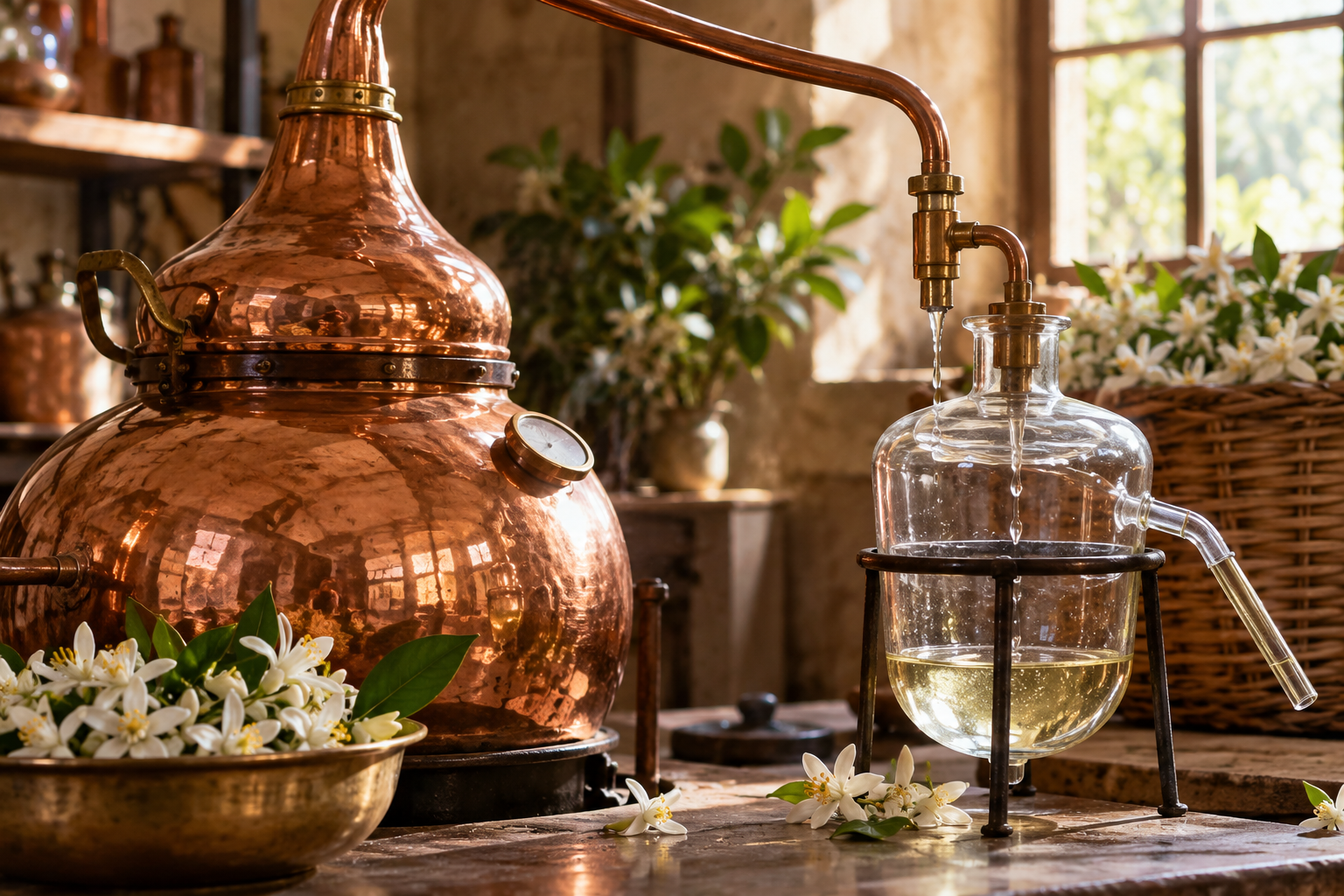
What does neroli pair with?
Neroli pairs with citrus, other white florals, woods, musks and amber, and it softens what it touches. It works as a bridge between a bright opening and a warmer heart.
| Partner family | What neroli adds | Product direction |
|---|---|---|
| Bergamot, grapefruit, mandarin | Floral softness and less bitterness | Fresh room sprays, diffusers |
| Jasmine, tuberose, orange blossom | Lift and brightness for heavy florals | Floral candles, perfume oils |
| Cedar, sandalwood, vetiver | A light top over a dry wood base | Hotel-style and spa scents |
| Musk, amber, tonka | A clean, luminous opening on a warm base | Soft, skin-like and cozy blends |
| Fig, green tea | Juicy, leafy freshness | Green and tea-style scents |
For related notes, see our guides to jasmine, musk and amber, and our explainer on why citrus notes are so popular in fragrance.
How is neroli different from bergamot and jasmine?
Neroli is more floral and clean than bergamot, and lighter and greener than jasmine. Bergamot reads as a sweeter, juicier citrus peel, while jasmine is a richer, creamier flower with a warm depth.
- Neroli vs bergamot: neroli leans floral; bergamot leans fruity and zesty.
- Neroli vs jasmine: neroli is fresh and subtle; jasmine is sweet, creamy and heady.
- Neroli vs orange: neroli smells more floral, green and honeyed than fruity.
What should brands and buyers check?
Check five things before you put a neroli scent in a range: what the name covers, how the profile behaves in your base, how stable it is, what the documents say and what the minimum order is.
- What “neroli” means in the formula: it can be natural neroli oil, an orange blossom accord or a blend. Ask which, and keep product claims in line with the answer.
- Batch variation: the profile shifts with sample and process, so keep a retained reference and compare each batch to it.
- Base compatibility: light citrus-floral notes can fade in some wax and diffuser bases. Test scent throw and stability in your own format; our guide to weak candle scent covers common causes.
- Shelf life and storage: citrus-type oils can change with age and air exposure, so see our fragrance oil shelf life guide for storage questions.
- Documents: request the safety data sheet and IFRA documentation for the specific fragrance and batch, and check allergen labeling rules in your target markets. Our IFRA compliance guide explains what to ask for.
- Quantity: confirm the minimum order for the service you are buying, not a headline figure.
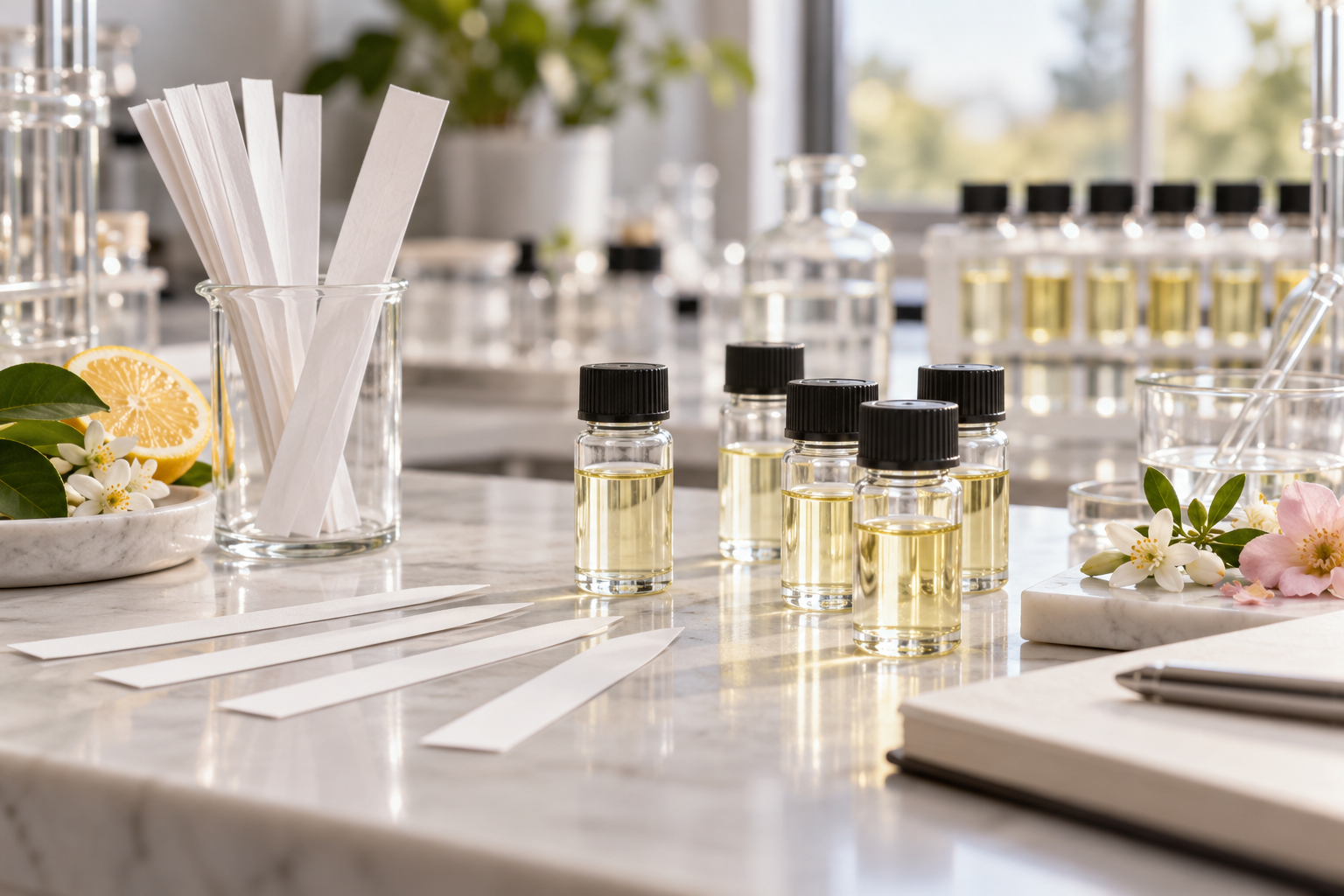
Neroli suits perfume oils and candle fragrance oils. For the broader family it sits between, browse our floral fragrance oils.
How does CQ Fragrance approach this?
CQ Fragrance (Dongguan Chengquan Fragrance Technology Co., Ltd.) is a fragrance oil manufacturer that lists custom fragrance development, fragrance duplication, OEM/ODM production, private label and wholesale supply. A neroli-style scent can be briefed through its custom fragrance development service.
- Brief to sample: a brand brings a concept or reference, and the scent is sampled and adjusted before production.
- Library: CQ Fragrance describes a library of production-tested formulas.
- Verification: the site says components are checked by GC-MS and formula records support batch consistency.
- Documents: the site lists IFRA-related documentation, MSDS and export documents. Buyers should still ask for the documents for the specific fragrance and batch.
- Minimums depend on the service: its OEM/ODM page lists production from 1 kg per fragrance, its wholesale page lists bulk supply from 100 L per fragrance, and its private label page lists finished products from 500 units per SKU. Confirm terms per project.
The site also says one scent can often be adapted across candles, diffusers and sprays, with performance testing in each format.
Developing a neroli scent for your range?
Share your scent brief and product format, and CQ Fragrance can help with custom development, OEM/ODM production or private label sampling.
Request a quoteFrequently Asked Questions
What does neroli smell like in perfume?
Neroli in perfume smells fresh, floral and lightly citrusy, with a green opening and a soft honeyed heart. It usually sits between the top and heart notes and links bright citrus to richer florals.
Is neroli the same as orange blossom?
Neroli is not the same as orange blossom absolute, although both come from bitter orange blossoms. Neroli is distilled and smells lighter and greener, while the solvent-extracted absolute smells richer, sweeter and more honeyed.
Does neroli smell like orange?
Neroli does not smell much like orange fruit. It is more floral, green and honeyed than a juicy peel, with only a gentle bitter-citrus brightness.
Is neroli a strong scent?
Neroli is a light scent that sits close rather than projecting. Brands that want more presence usually pair it with musk, amber or wood so the freshness lasts longer.
Can neroli be used in candles and diffusers?
Neroli can be used in candles and diffusers, but each format needs its own performance test. Light citrus-floral notes can fade, so check scent throw and stability in your own wax or diffuser base before launch.
Bottom line
Neroli smells bright, green and floral-citrus, with a honeyed heart and a clean finish. It differs from orange blossom absolute and petitgrain, and its chemistry varies by sample. Ask what is in the neroli you are buying, test it in your own base, and request documents for the exact fragrance and batch.