
Short answer
Tuberose smells rich, creamy and heady, a white floral with honeyed sweetness, a green, waxy edge and sometimes a warm, animalic depth. It is one of the boldest floral notes, stronger and more enveloping than jasmine. Perfumers use it as a lead flower or soften it with woods, musk and amber. Its character changes a lot with the extraction method and the blend.
Key Takeaways
- Tuberose is a creamy, sweet, heady white floral with green and sometimes animalic facets.
- It is a powerful note, so it is usually balanced with grounding notes in products.
- Extraction method changes both the yield and the chemistry of tuberose absolutes.
- Natural tuberose is a low-yield material, so brands should confirm whether a scent uses natural material or a tuberose accord.
- Test tuberose in your own base and request documents for the exact fragrance and batch.
What does tuberose smell like?
Tuberose smells sweet, creamy and intensely floral, like a white flower with honey, milk and a green, waxy note around it. It is fuller and more narcotic than most florals.
The main facets of tuberose are:
- Creamy: a soft, milky richness, sometimes compared to coconut or vanilla.
- Sweet and honeyed: a warm sweetness that builds as it dries down.
- Heady: a big, room-filling presence that can feel overwhelming in high doses.
- Green and waxy: a fresh, slightly mentholated or leafy edge.
- Warm and animalic: a skin-like depth that perfumers often link to indolic character.
Tuberose does not smell like a rose, despite the name.
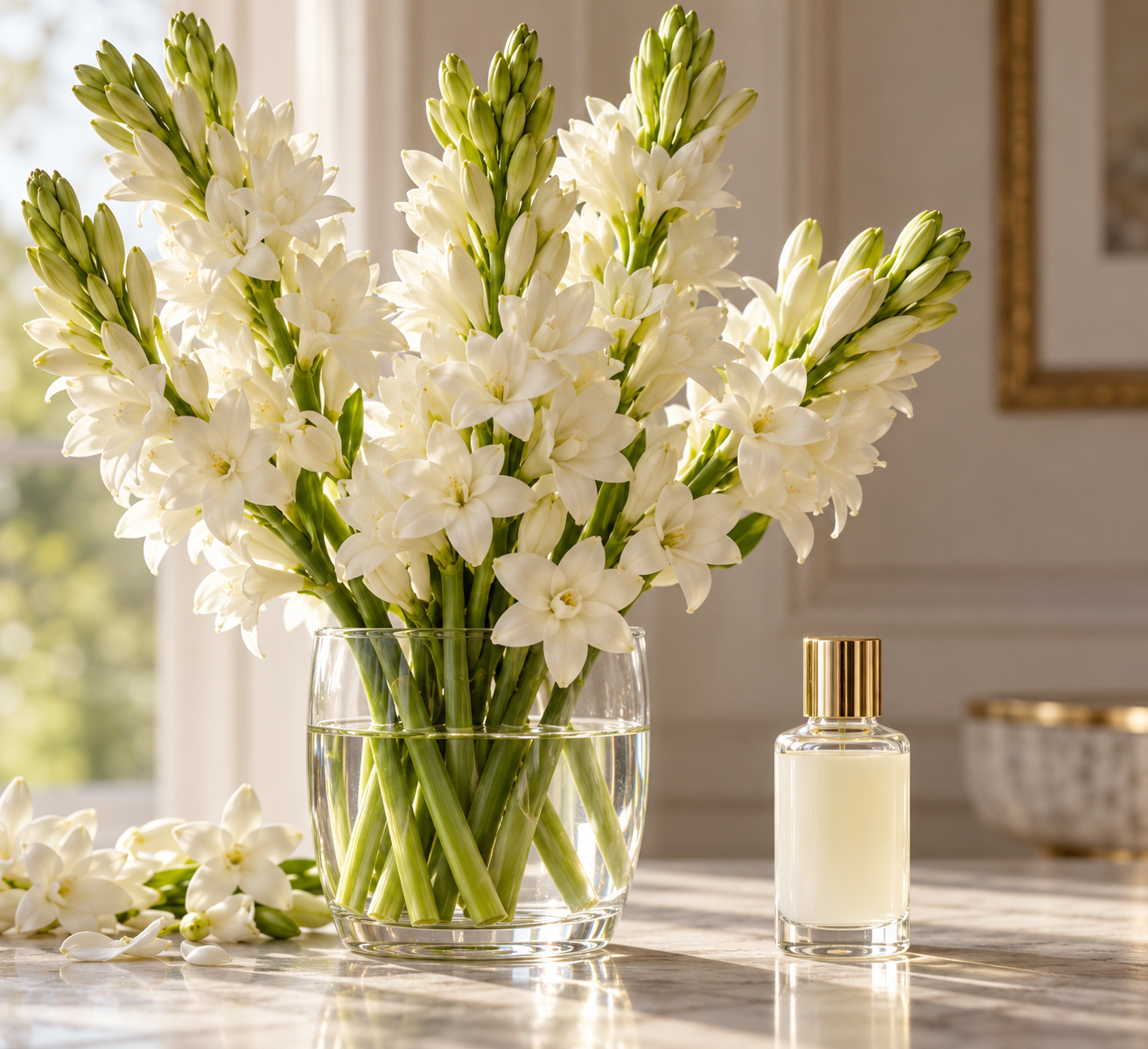
Is tuberose a strong scent?
Yes, tuberose is a strong scent and one of the boldest in the floral family. It tends to dominate a blend unless other notes balance it.
- High presence: a small dose can already be noticeable, so dose it carefully.
- Soften with base notes: musk, sandalwood and amber make it feel closer to the skin.
- Freshen with top notes: citrus, green notes or neroli lift it and make it feel lighter.
- Test in the finished format: a strong flower in a bottle can become more polite in wax or a diffuser, or the reverse.
How is tuberose different from jasmine and gardenia?
Tuberose is bolder, creamier and more enveloping than jasmine, while jasmine is lighter and more even. Gardenia and tuberose are close cousins in effect, but gardenia is often described as softer, greener and more fruit-like.
| Note | Typical character | Strength | Common use |
|---|---|---|---|
| Tuberose | Creamy, heady, waxy-green, sometimes animalic | Very strong | Lead flower in bold white florals |
| Jasmine | Sweet, honeyed, fruity, rounded | Strong but more even | Lead or supporting floral |
| Gardenia | Creamy, green, slightly fruity | Medium to strong | Soft white-floral accords |
| Neroli | Fresh, floral-citrus, clean | Light | Bright top over heavier florals |
These descriptions are general perfumery vocabulary, not measurements. For comparison, see our guides to jasmine and neroli.
How is tuberose absolute made?
Tuberose absolute is made by extracting the flowers by enfleurage or solvents, and the method changes the result. A 2009 study in Agriculture and Natural Resources compared four extraction methods on the doubleflower variety of Polianthes tuberosa and analyzed the absolutes by GC-MS.
The abstract reports these yields:
- Cold enfleurage: about 0.31%.
- Hot enfleurage: about 6.58%, the highest.
- Hexane extraction: about 0.03%.
- Petroleum ether extraction: about 0.02%.
The main chemical component also depended on the method. Both enfleurage absolutes were dominated by methyl benzoate, the hexane absolute by benzyl benzoate and the petroleum ether absolute by pentacosane.
Two practical points follow. Different extraction routes give chemically different materials, and low solvent yields help explain why real tuberose is costly. These are results from one study of one variety, not a commercial specification.
What does tuberose blend with?
Tuberose blends with other white florals, woods, amber, musk, citrus and creamy notes, and the partner sets its mood. Fresh partners make it bright; warm partners make it sensual.
| Partner | Effect on tuberose | Product direction |
|---|---|---|
| Jasmine, orange blossom, ylang-ylang | Extends the white-floral bouquet | Perfume oils, floral candles |
| Sandalwood, cedar | Grounds the flower with a creamy wood base | Hotel-style and premium scents |
| Amber, vanilla | Adds resinous warmth for cool-weather ranges | Cozy candles, evening scents |
| Musk | Softens it and makes it feel skin-close | Modern, soft-focus blends |
| Neroli, citrus, green notes | Adds brightness and freshness | Warm-weather diffusers, room sprays |
| Coconut | Leans into a creamy, tropical effect | Summer and beach-style scents |
For related base notes, see our guides to amber, musk and vanilla. For the wider family, browse our floral fragrance oils.
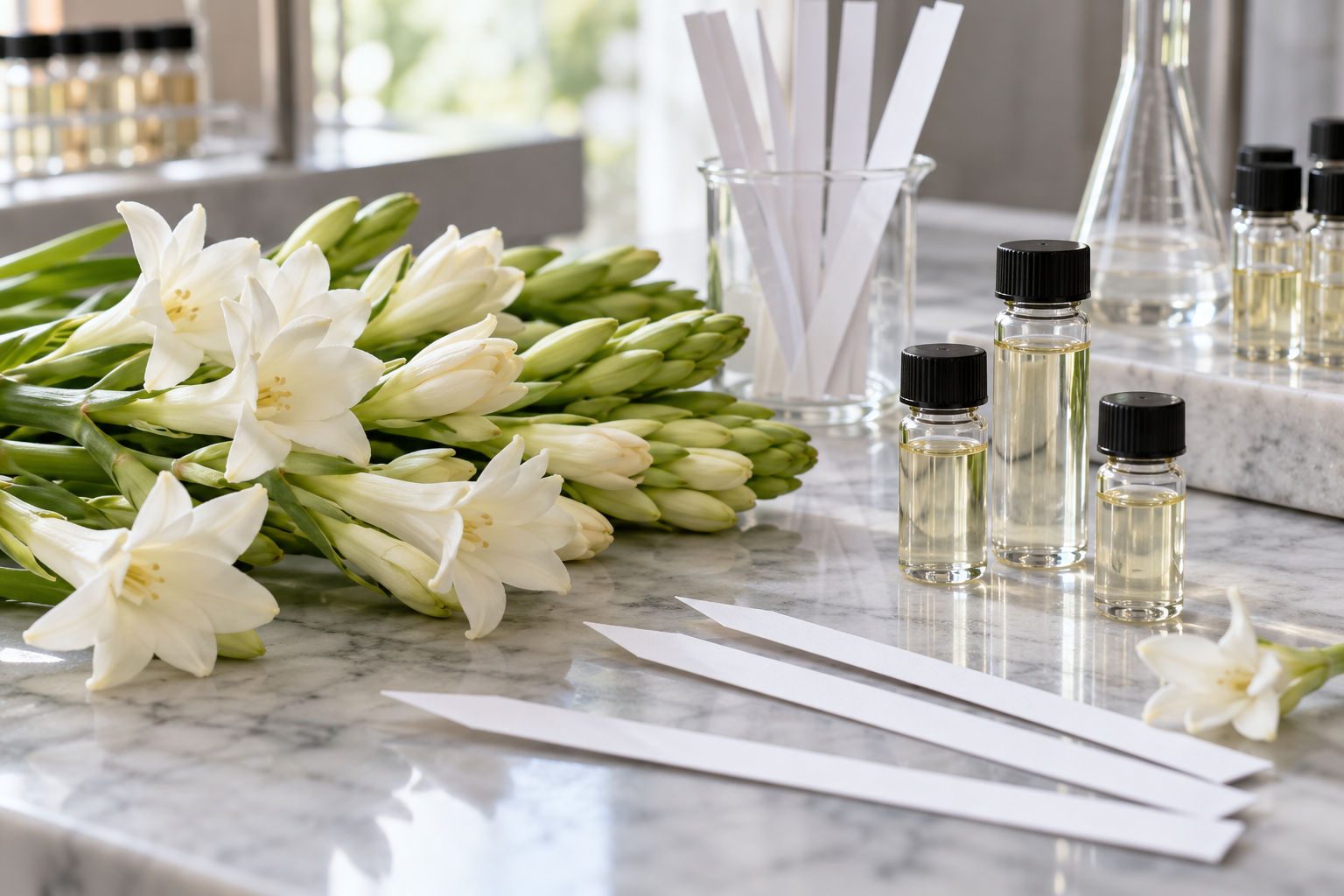
What role does tuberose play in a fragrance oil?
Tuberose plays three roles: lead flower, heart accent and creamy bridge. The role you choose sets the dose, the cost and the way the product feels.
- Lead: tuberose is the main idea, such as a bold white-floral perfume oil or candle.
- Accent: a small amount adds a creamy, narcotic note to jasmine, rose or fruity florals.
- Bridge: it links sweet notes (vanilla, coconut) with fresh ones (citrus, green).
What should brands and buyers check?
Check six things before you add a tuberose scent to a range: what the name means, the dose, the base, the batch, the documents and the minimum order.
- What “tuberose” means in the formula: it can be natural absolute, a tuberose accord or a blend. Ask which, and keep claims in line with the answer.
- Dose and intensity: strong florals can overpower a small room or a sensitive customer, so approve the strength in the finished format.
- Base compatibility: test scent throw, color and stability in your own wax, diffuser base or perfume-oil carrier. Our guide on weak candle scent lists common causes.
- Batch variation: extraction route and season change the chemistry, so keep a retained reference sample for each approved batch.
- Documents: request the safety data sheet and IFRA documentation for the specific fragrance and batch, and check allergen labeling rules in your target markets. Our IFRA compliance guide explains what to ask for.
- Quantity: confirm the minimum order for the service you are buying, not a headline figure.
Tuberose suits perfume oils and candle fragrance oils, but each format needs its own performance test.
How does CQ Fragrance approach this?
CQ Fragrance (Dongguan Chengquan Fragrance Technology Co., Ltd.) is a fragrance oil manufacturer that lists custom fragrance development, fragrance duplication, OEM/ODM production, private label and wholesale supply. Its site lists Floral among its fragrance families and describes concentrated alcohol-free perfume oils that customers dilute with their own alcohol.
- Brief to sample: a brand brings a tuberose concept or reference, and the scent is sampled and adjusted before production. See custom fragrance development.
- Library: CQ Fragrance describes a library of production-tested formulas.
- Verification: the site says components are checked by GC-MS and formula records support batch consistency.
- Documents: the site lists IFRA-related documentation, MSDS and export documents. Buyers should still ask for the documents for the specific fragrance and batch.
- Minimums depend on the service: its OEM/ODM page lists production from 1 kg per fragrance, its wholesale page lists bulk supply from 100 L per fragrance, and its private label page lists finished products from 500 units per SKU. Confirm terms per project.
The site also says one scent can often be adapted across candles, diffusers and sprays, with performance testing in each format.
Developing a tuberose scent for your range?
Share your scent brief and product format, and CQ Fragrance can help with custom development, OEM/ODM production or private label sampling.
Request a quoteFrequently Asked Questions
What does tuberose smell like in perfume?
Tuberose in perfume smells creamy, sweet and heady, with a green, waxy edge and sometimes a warm, animalic depth. It is usually the lead flower or a bold heart note.
Does tuberose smell like roses?
Tuberose does not smell like roses despite the name. It is a creamy white floral closer to jasmine or gardenia.
Is tuberose a strong scent?
Tuberose is a strong scent and one of the boldest florals. Blending it with woods, musk or amber softens it, and citrus or neroli makes it fresher.
Why is tuberose absolute expensive?
Tuberose absolute is expensive because natural extraction gives low yields. In a 2009 study the solvent extractions yielded about 0.03% and 0.02%, and even the best enfleurage route reported about 6.58%.
What scents pair well with tuberose?
Tuberose pairs well with jasmine, sandalwood, amber, vanilla, musk, neroli and coconut. Warm partners make it sensual and fresh partners make it brighter.
Bottom line
Tuberose smells creamy, sweet and heady, with a green edge and, in some types, a warm animalic depth. It is bold, so balance and dose matter, and extraction route changes the material. Ask what is in the tuberose you are buying, test it in your own base, and request documents for the exact fragrance and batch.