
Short answer
To make wax melts, weigh the wax, melt it gently, stir in fragrance oil off the heat, pour into molds, let it set, then cure it before testing in a warmer. The wax maker’s data sheet sets the safe fragrance load and temperatures. Use fragrance oil made for wax, weigh by percentage, and log every test batch.
Key Takeaways
- Wax melts are unwicked scented wax, so the whole recipe is wax, fragrance oil and optional color.
- Fragrance load is a weight percentage of the wax; the maximum depends on the wax and is set by the wax supplier.
- Add fragrance off the heat and stir well; pour at the temperature your wax data sheet recommends.
- Cure the melts and test them in a warmer; scent in the pot is not the same as scent in a room.
- Scented wax melts release terpenes, and one 2025 study found they can form indoor nanoparticles, so buyers should ask for safety documents.
What do you need to make wax melts?
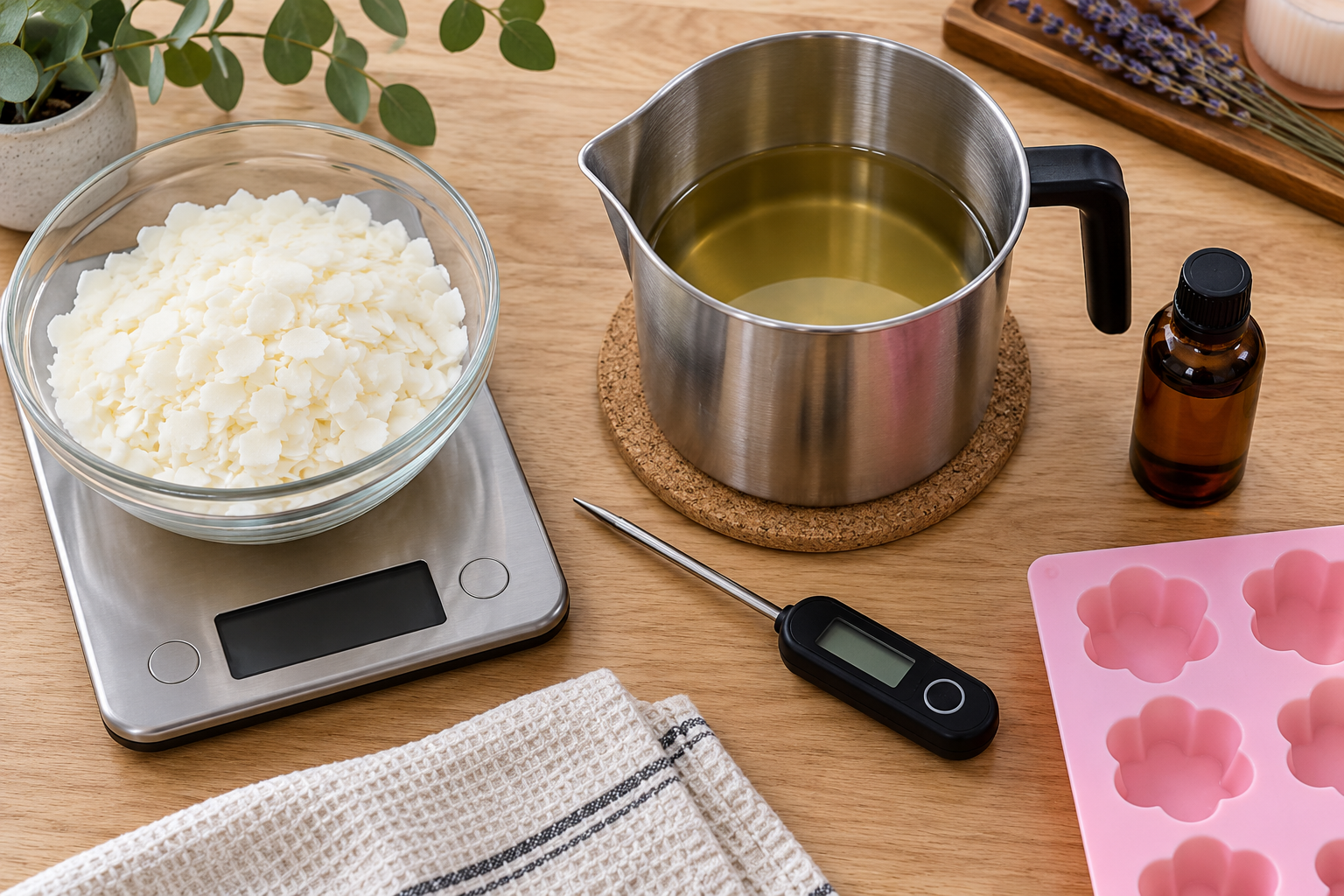
You need wax, fragrance oil, a heat source and a mold. Everything else is optional or a quality-control tool.
- Wax: paraffin, soy, coconut blends or a ready-made melt wax. Choose one the supplier sells for wax melts.
- Fragrance oil: choose an oil made for wax. Our candle fragrance oils are one example of the category.
- Color (optional): dye or mica made for the wax you use.
- Melting vessel: a double boiler or a pouring pot on a controlled heat source.
- Digital scale and thermometer: weigh by weight, not volume, and measure temperature in the center of the pot.
- Molds: silicone molds or plastic clamshells.
How do you make wax melts step by step?
Follow nine steps in order, and write down the wax, fragrance, percentage and temperatures for every batch. Because suppliers give different numbers for different waxes, take the exact temperatures from your wax data sheet.
- Weigh the wax. Decide the batch size in grams and weigh the wax into the pot.
- Melt it gently. Heat slowly with stirring and do not exceed the maximum temperature on the data sheet.
- Add color if wanted. Stir until the color is fully dissolved.
- Remove from heat and let it cool a little. Adding fragrance to very hot wax can drive some of it off before the melt sets.
- Weigh and add the fragrance oil. Calculate it as a percentage of the wax weight.
- Stir thoroughly. Mix long enough to blend the oil into the wax, scraping the sides and bottom.
- Pour into molds. Pour slowly to avoid bubbles, at the temperature the wax maker recommends.
- Let the melts set. Cool at room temperature, then unmold.
- Cure and test. Rest the melts, then test them in a warmer before you call the recipe finished.
Retail how-to guides give very different curing times, from a few days to a couple of weeks, so the cure time is something to test for your own wax and fragrance.
How much fragrance oil do you add to wax melts?
You add fragrance oil as a percentage of the wax weight, and the maximum depends on the wax. The wax supplier’s data sheet gives the upper limit; going above it can cause oil to sweat out of the wax.
The arithmetic is simple: wax weight multiplied by the fragrance percentage gives the oil weight. The table shows examples for a 500 g batch. These are calculations, not recommended loads.
| Wax weight | Fragrance % | Fragrance oil weight |
|---|---|---|
| 500 g | 6% | 30 g |
| 500 g | 8% | 40 g |
| 500 g | 10% | 50 g |
Start at a lower percentage within your wax maker’s limit, then raise it in small steps only if the scent is too weak. More oil is not always stronger; past the wax’s limit, it can leave an oily surface and weaken the melt.
How do you choose wax and fragrance for wax melts?
Choose a wax that holds fragrance well and releases it at warmer temperatures, then match it with an oil designed for wax. The wax decides how much oil it can hold and how the scent travels.
- Paraffin: generally holds and throws fragrance strongly, which is why many melt makers use it.
- Soy and plant-based waxes: a softer, more natural-positioned choice that can need more testing for scent throw.
- Blends: mix properties; follow the blend maker’s limits.
- Fragrance oil: pick an oil suited to wax, and check its flash point and compatibility; see our flash point guide.
If you are choosing between formats, our wax melt vs candle comparison explains scent throw and safety differences, and our guide on choosing fragrance for candle making applies to melts as well.

Why do wax melts fail, and how do you fix them?
Most wax melt problems come from fragrance load, temperature or cure time. Fix one variable at a time and keep a batch log.
| Problem | Likely cause | What to test |
|---|---|---|
| Weak scent | Low load, oil added too hot, no cure, or wax that holds little oil | Raise the load in small steps within the limit; add fragrance off the heat; allow cure time |
| Oily or wet surface | Fragrance above what the wax can hold | Lower the load; check the wax limit |
| Cloudy or frosted look | Wax type, cooling speed or pour temperature | Change the pour temperature or cooling; try a different wax |
| Bubbles or sink holes | Pouring too fast or too cool | Pour slowly and adjust the pour temperature |
| Color changes | Fragrance oil that darkens, or dye not suited to the wax | Test small batches of color and oil together |
For scent that seems weak in finished products, our guide on why a candle does not smell strong covers many of the same causes.
Are scented wax melts safe? What does the research say?
Scented wax melts release fragrance compounds into indoor air, and one 2025 study found they can form indoor nanoparticles. The study by Patra and colleagues in Environmental Science & Technology Letters measured nanoparticle formation from scented wax melt use in a residential test house.
According to the abstract, terpenes released from the melts react with indoor ozone and start new particle formation, producing nanoparticle concentrations above 106 cm-3. The authors say these levels are comparable to those from combustion-based scented candles, gas stoves, diesel engines and natural gas engines.
The authors also state that more research is needed on the toxicological properties of the newly formed nanoparticles. This guide does not give medical or legal advice. Brands should ventilate their testing areas, follow warmer and wax instructions, and check the labeling and safety rules in each market they sell to.
What should brands and buyers check?
If you make wax melts for sale, check six things: the fragrance oil’s documents, its fit for wax, the load limit, your batch process, the warmer you recommend and the label.
- Documents: request the safety data sheet and IFRA documentation for the specific fragrance and batch. Our IFRA compliance guide explains what to ask for.
- Fit for wax: confirm the oil was designed for wax and tested for scent throw and appearance in your wax.
- Load limit: record the wax supplier’s maximum and stay within it.
- Batch control: weigh by percentage, log temperatures and lot numbers, and keep a retained sample of each batch.
- Warmer pairing: test your melts in the warmers you sell or recommend, since the heat source changes performance.
- Labels and claims: check labeling and allergen rules for your target markets rather than copying another brand’s label.
For scaling up from a hobby recipe to a product range, see our guide to starting a private label candle line.
How does CQ Fragrance approach this?
CQ Fragrance (Dongguan Chengquan Fragrance Technology Co., Ltd.) is a fragrance oil manufacturer that lists custom fragrance development, fragrance duplication, OEM/ODM production, private label and wholesale supply, and it lists candle fragrance oils among its products.
- Brief to sample: a brand brings a scent brief and product format, and the scent is sampled and adjusted before production.
- Library: CQ Fragrance describes a library of production-tested formulas.
- Verification: the site says components are checked by GC-MS and formula records support batch consistency.
- Documents: the site lists IFRA-related documentation, MSDS and export documents. Buyers should still ask for the documents for the specific fragrance and batch.
- Minimums depend on the service: its wholesale page lists bulk supply from 100 L per fragrance, its OEM/ODM page lists production from 1 kg per fragrance, and its private label page lists finished products from 500 units per SKU. Confirm terms per project.
The site also says one scent can often be adapted across candles, diffusers and sprays, with performance testing in each format.
Making wax melts for your own brand?
Share your scent brief and product format, and CQ Fragrance can help with custom development, OEM/ODM production, wholesale supply or private label sampling.
Request a quoteFrequently Asked Questions
How much fragrance oil do you use to make wax melts?
You use fragrance oil as a percentage of the wax weight, and the wax supplier’s data sheet sets the maximum. Start below the limit and raise the load in small steps only if the scent is too weak.
Can you make wax melts without a wick?
You can make wax melts without a wick because they are unwicked scented wax. They are warmed in a melter or warmer instead of burned.
How long do wax melts need to cure?
Wax melts need a cure time that depends on the wax and fragrance, and retail guides range from a few days to a couple of weeks. Test your own recipe by smelling and warming samples at set intervals.
What temperature do you add fragrance oil to wax melts?
You add fragrance oil to wax melts at the temperature your wax data sheet recommends, after taking the wax off the heat. Adding it to very hot wax can drive some of it off.
Can you use candle fragrance oil for wax melts?
You can often use candle fragrance oil for wax melts if the supplier states it suits wax, but test scent throw and appearance in your wax. Check the load limit and the flash point information as well.
Bottom line
Wax melts are simple to make but easy to get wrong in fragrance load, temperature and curing. Follow your wax maker’s data sheet, weigh by percentage, log every batch and test in a warmer. For products you sell, request documents for the exact fragrance and batch and check the labeling rules in your markets.