
Short answer
To make perfume from fragrance oil, blend the oil with perfumer’s alcohol at roughly 15–25% fragrance by weight, let the mixture rest in a dark glass bottle for two to four weeks, then filter and bottle it. For an oil-based perfume, dilute the fragrance oil in a carrier oil such as jojoba instead of alcohol.
Key Takeaways
- Alcohol perfume uses fragrance oil plus perfumer’s alcohol; oil perfume uses fragrance oil plus a carrier oil.
- A typical alcohol-perfume load is 15–25%, but the real ceiling is the IFRA limit for the oil you use.
- Resting (maceration) for two to four weeks lets the blend settle before you judge the scent.
- A kitchen recipe is not a production process. Brands need documents, stability tests and label checks before selling.
What does it mean to make perfume from fragrance oil?
Making perfume from fragrance oil means diluting a concentrated scent oil in a carrier so it is safe and pleasant to wear. The fragrance oil is the scent; the carrier (alcohol or oil) controls strength, spray or roll-on format and how fast it evaporates.
Fragrance oils are blended aroma materials that can be natural, synthetic or both. They differ from essential oils, which are single plant extracts. For the full difference, read fragrance oil vs essential oil, and for how concentrates are produced, see how fragrance oils are made.
Always start from a fragrance oil intended for skin or fine-fragrance use. Candle-only oils are not designed to be worn.
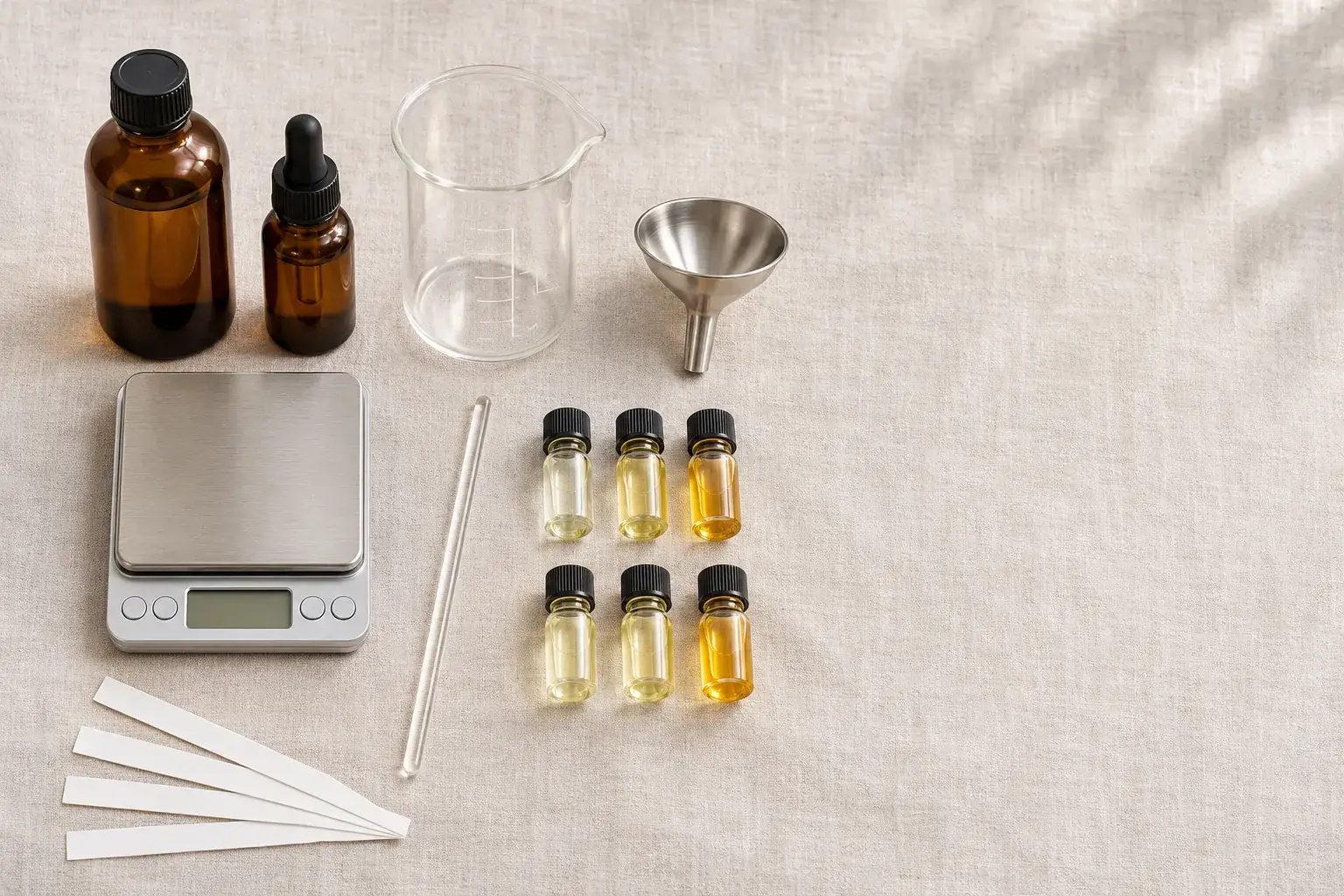
What do you need to make perfume from fragrance oil?
You need a skin-safe fragrance oil, a carrier, a gram scale, clean glassware and a dark bottle. Weigh by gram, not by drop or by volume, so you can repeat the blend.
- Fragrance oil: one or more oils intended for perfume use, with safety documents from the supplier.
- Perfumer’s alcohol: a fragrance-grade ethanol sold for perfume making. Do not use rubbing alcohol or household products.
- Carrier oil (for oil perfume): jojoba, fractionated coconut or sweet almond oil.
- Distilled water (optional): some recipes add a small share to lighten the strength. Test for cloudiness.
- Tools: gram scale, glass beaker, glass or steel stirrer, funnel, pipette, coffee filter or lab filter paper, labels.
- Bottles: dark glass bottles with a tight spray pump or roller ball. Light and air degrade perfume.
What ratio of fragrance oil to alcohol should you use?
A common starting range is 15–25% fragrance oil with the rest alcohol, though sources vary and the exact figure depends on the oil. Treat these as testing ranges, not guaranteed standards.
| Strength style | Typical fragrance share | Alcohol | Notes |
|---|---|---|---|
| Eau de cologne style | about 3–8% | Most of the blend | Light, short wear |
| Eau de toilette style | about 8–15% | Most of the blend | Everyday strength |
| Eau de parfum style | about 15–25% | Most of the blend | Stronger, longer wear |
| Oil perfume (roll-on) | about 10–20% in carrier oil | None | Sits close to the skin |
Strength names are style labels here, not legal definitions, and brands use different ranges. The upper limit is always set by the IFRA limit for the specific oil. IFRA’s IFRA Standards page explains that the Standards set limits for certain ingredients and that its guidance contains product category tables.
How do you make perfume from fragrance oil step by step?
Make alcohol perfume in five steps: weigh, blend, rest, filter and bottle. A 30 g test batch at 20% is 6 g fragrance oil and 24 g alcohol.
- Weigh the fragrance oil. Put the oil in a clean glass beaker on the scale and note the weight.
- Add the alcohol. Pour perfumer’s alcohol over the oil until you reach the target total weight. Keep it away from flames and heat.
- Stir gently. Stir for about 30 seconds until clear. Do not shake hard.
- Rest in a dark bottle. Seal the blend in a dark glass bottle and store it in a cool, dark place for two to four weeks. Shake or turn it gently once a week.
- Chill, filter and bottle. If the blend is cloudy, chill it for a day, filter it and then fill the final spray bottle through a funnel. Label it with the date and formula.
For an oil perfume, skip the alcohol: weigh the carrier oil, add the fragrance oil, mix and rest for a day or two. The solid and roll-on perfume guide covers these formats in detail.
Why does perfume need to rest or age?
Perfume rests so the oil and alcohol can blend fully and the scent can settle before you judge it. Many makers wait two to four weeks, and some blends still change after that.
- Blending: a fresh blend can smell sharp from the alcohol, and this softens over days.
- Clarity: sediment or cloudiness often shows up during rest, which is when you filter.
- Judging the scent: smell it on skin, not only on paper, because skin changes how notes develop.
- Storage: keep it away from light and heat, since both degrade perfume. The fragrance oil shelf life guide explains how storage affects oils.

Is perfume made from fragrance oil safe on skin?
It can be, but only if the fragrance oil is intended for skin contact and the blend stays within the IFRA limit for its product category. Safety depends on the specific oil and the final concentration.
- Use the right grade: do not use oils sold only for candles or cleaning products on the skin.
- Check the limit: ask the supplier which IFRA category and maximum level their documents show for your product type. IFRA lists individual standards in its Standards library.
- Patch test: try a small amount on a small area first and stop if irritation appears.
- Keep away from children and pets, and store in labeled, closed bottles.
This is general guidance, not medical advice. See skin-safe fragrance oil for what soap and lotion brands should check.
What should brands check before selling perfume made from fragrance oil?
Brands should confirm the fragrance grade, safety documents, stability and labeling rules before selling any perfume. A small test batch does not prove a product is ready for the market.
- Documents: request the safety data sheet and IFRA-related documents for the specific fragrance and batch. See the IFRA compliance guide for buyers.
- Alcohol-free concentrate or finished perfume: decide whether you buy a concentrate to dilute yourself or a finished product.
- Scale-up: filtering, mixing speed and rest time change in larger batches. Test each batch size.
- Stability: check color, clarity and scent in your final bottle and in warm shipping conditions.
- Regulation and labeling: perfume is regulated as a cosmetic in many markets. Confirm local requirements; this article is not legal advice.
The guide to starting a perfume brand covers the wider launch steps, and the custom fragrance development cost guide covers budget.
How does CQ Fragrance approach this?
CQ Fragrance supplies perfume oils as alcohol-free concentrated oils, and its pages list custom development, fragrance duplication, OEM/ODM production, private label and wholesale supply.
- Concentrates for fine fragrance: its perfume oils category lists alcohol-free concentrates, with the customer adding their own alcohol.
- OEM/ODM production: production MOQ starts from 1 kg per fragrance, as listed on its OEM/ODM page.
- Quality checks: it states that it verifies composition with GC-MS and keeps formula records for batch consistency.
- Documents: its site lists IFRA documentation, MSDS and export documents. Ask for those specific to your fragrance and batch.
- Custom scents: a brand can start from a concept or reference through custom fragrance development.
MOQ depends on the service, so confirm the right figure, samples and lead time for your own project.
Planning a perfume line from fragrance oil?
Share your scent brief, format and target market, and discuss samples, custom development or OEM/ODM with CQ Fragrance.
Request a quoteFrequently Asked Questions
How do you make perfume from fragrance oil?
You make perfume from fragrance oil by blending the oil with perfumer’s alcohol at about 15–25% fragrance, resting it in a dark bottle for two to four weeks, then filtering and bottling. For an oil perfume, use a carrier oil instead of alcohol.
How much fragrance oil do you put in perfume?
Most makers use about 15–25% fragrance oil for an eau de parfum style blend, and less for lighter styles. The maximum is set by the IFRA limit for the specific oil.
How do you make perfume oil from fragrance oil?
You make perfume oil from fragrance oil by diluting it in a carrier oil such as jojoba or fractionated coconut oil, usually at 10–20% fragrance. No alcohol is needed, and the blend should rest for a day or two.
How long should perfume age before use?
Perfume made from fragrance oil should age for about two to four weeks before use. Store it in a dark glass bottle in a cool place and smell it again after resting.
Can I use candle fragrance oil to make perfume?
No, you should not use candle-only fragrance oil to make perfume. Use a fragrance oil intended for skin or fine-fragrance use, and check its IFRA documents.
Bottom line
Perfume from fragrance oil comes down to a skin-safe oil, a measured carrier, a rest period and a filter. Keep within the IFRA limit, and treat any home recipe as a test batch before you build a product.