
Short answer
To make solid perfume, melt beeswax with a carrier oil or butter, stir in skin-safe fragrance oil, pour the blend into a small tin and let it set. To make roll-on perfume, dilute fragrance oil in a liquid carrier oil and fill a roller bottle. Both formats are alcohol-free and take under an hour of hands-on work.
Key Takeaways
- Solid perfume uses wax plus oil; roll-on perfume uses oil only. Neither needs perfumer’s alcohol.
- Start with a fragrance load of about 5–10% in solid perfume and 10–20% in roll-on, then adjust by testing.
- Use a fragrance oil that is rated for skin contact, and keep within the IFRA limit for your product type.
- A bench recipe is not a production formula. Brands should confirm documents, stability and labeling before selling.
What are solid perfume and roll-on perfume?
Solid perfume is a wax-based balm that you rub on the skin, and roll-on perfume is a thin oil that you apply with a roller ball. Both are anhydrous (no water) and alcohol-free, so the scent sits close to the skin and fades more gently than a spray.
The three common formats compare like this:
| Format | Base | Container | Feel on skin | Best for |
|---|---|---|---|---|
| Solid perfume | Beeswax or similar wax, carrier oil, optional butter | Tin, lipstick-style tube, locket | Soft balm | Travel, gifts, small-batch launches |
| Roll-on perfume | Liquid carrier oil such as jojoba or fractionated coconut oil | Glass roller bottle | Light oil | Everyday carry, sample-size products |
| Alcohol spray | Perfumer’s alcohol, sometimes water | Spray bottle | Dry, projects outward | Full-size fine fragrance |
For a wider comparison of oil and spray formats, read fragrance oil vs spray.
What do you need to make solid or roll-on perfume?
You need a skin-safe fragrance oil, a carrier oil, a wax for the solid version, containers and basic heating and measuring tools. Weigh ingredients on a gram scale instead of counting drops, because drop size changes with the oil.
- Fragrance oil: choose a grade intended for skin or fine fragrance use, and ask the supplier for its safety data sheet and IFRA-related documents.
- Carrier oil: jojoba, sweet almond, grapeseed or fractionated coconut oil. Fractionated coconut oil stays liquid, which suits roll-ons.
- Wax: beeswax pellets are the usual choice for solid perfume. Candelilla is a plant-based alternative that is typically used at a different ratio, so test it.
- Butter (optional): shea or cocoa butter makes the balm softer and smoother.
- Containers: small metal tins or tubes for solid perfume; glass roller bottles (typically 5–10 ml) for roll-on.
- Tools: gram scale, heat-safe cup, double boiler or a pan of hot water, glass or steel stirrer, small funnel or pipette, labels.
How do you make solid perfume step by step?
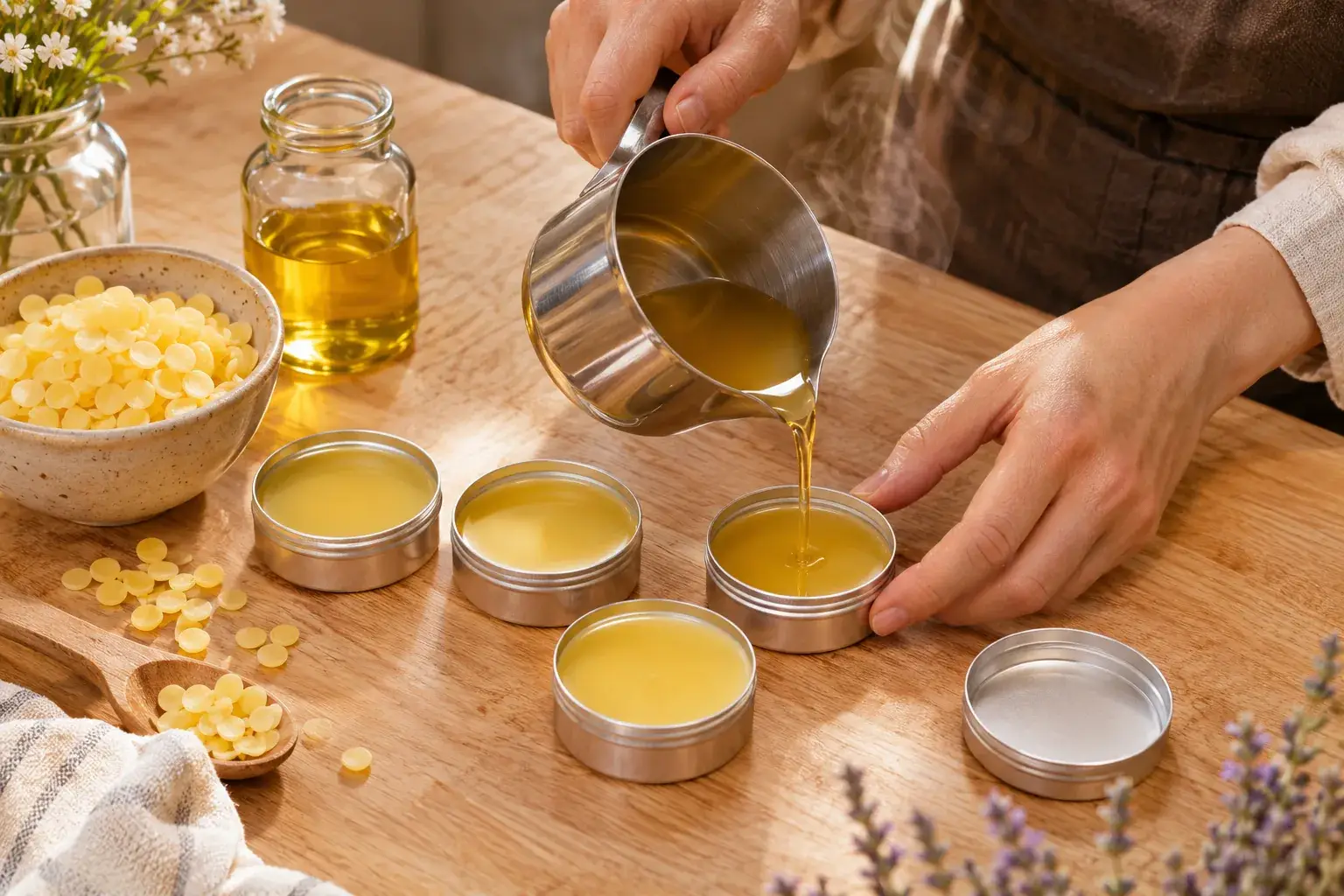
Make solid perfume by melting the wax and oil, cooling the blend slightly, adding the fragrance oil and pouring into tins. A 30 g batch is a practical test size, and the steps below use it.
This is a bench starting formula for testing, not a fixed standard:
| Ingredient | Share by weight | Amount in a 30 g batch |
|---|---|---|
| Beeswax | about 33% | 10 g |
| Carrier oil (for example jojoba) | about 40% | 12 g |
| Shea butter (optional) | about 17% | 5 g |
| Fragrance oil | about 10% | 3 g |
- Weigh everything. Put the wax, carrier oil and butter in a heat-safe cup. Weigh the fragrance oil separately.
- Melt gently. Place the cup in a double boiler and stir until the mixture is clear. Avoid direct high heat, because it can scorch the oils.
- Cool slightly. Take the cup off the heat and wait a minute or two so the fragrance oil does not flash off. Check the fragrance oil’s flash point if you are unsure; the flash point guide explains why it matters.
- Add the fragrance oil. Stir for about 30 seconds so the scent is evenly mixed.
- Pour fast. Fill the tins while the blend is still liquid. If it starts to thicken, warm it again briefly.
- Let it set. Leave the tins undisturbed at room temperature, usually for an hour or more, before closing the lids.
If the balm is too hard, raise the oil or butter share. If it is too soft, raise the wax share by a small step and test again.
How do you make roll-on perfume?
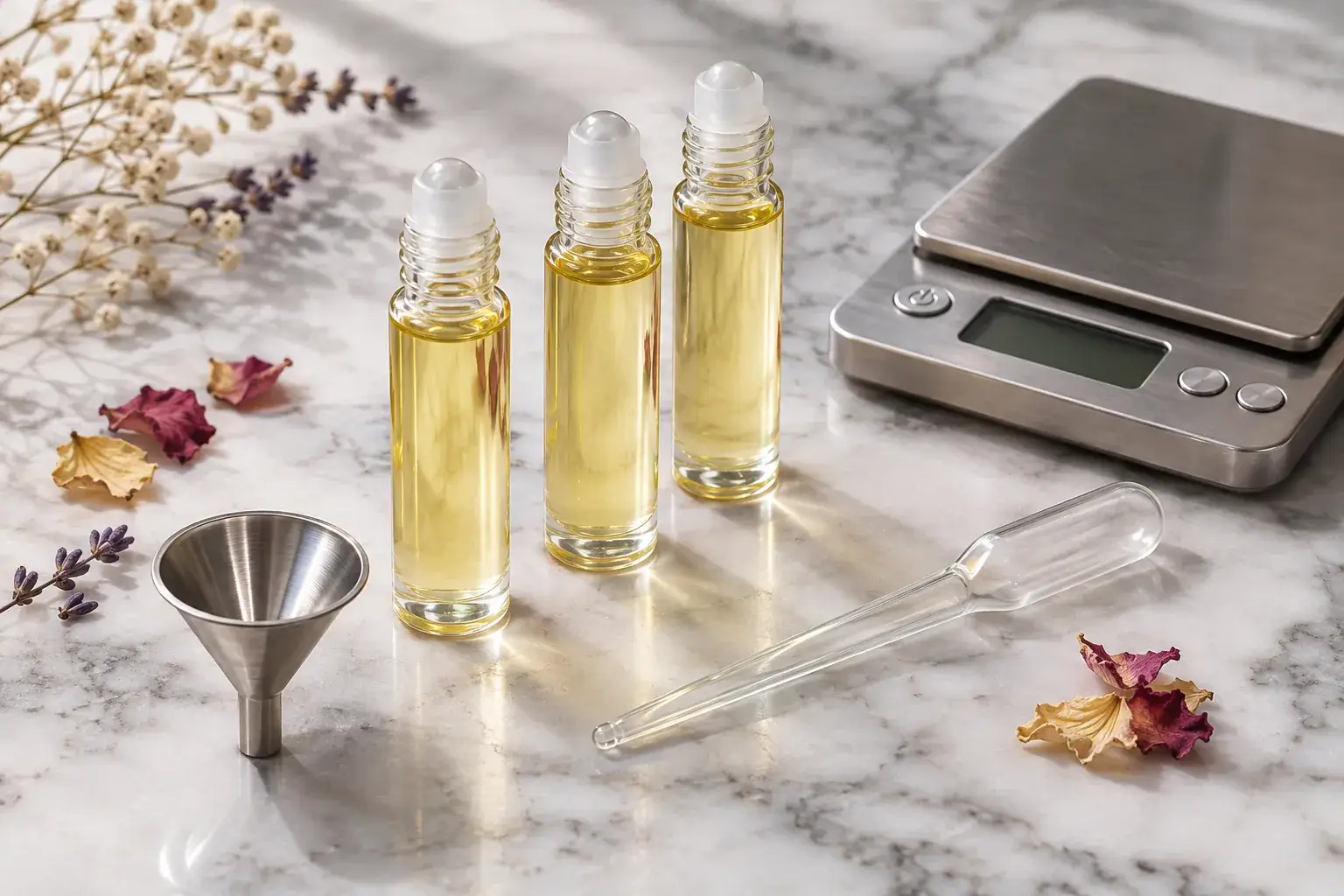
Make roll-on perfume by mixing fragrance oil into a liquid carrier oil and filling a roller bottle. No heating is needed, so it is the faster of the two formats.
A 10 ml bottle at a 15% load works out like this:
- Measure the carrier oil. Add about 8.5 g of carrier oil to a clean cup or directly into the bottle through a funnel.
- Add the fragrance oil. Add about 1.5 g of fragrance oil, which gives a 15% load by weight.
- Mix. Cap the bottle and roll or swirl it gently for a minute. Do not shake hard, because it traps air.
- Rest it. Let the bottle sit for a day or two, then smell it again. Some blends change as the oils settle.
- Label it. Write the fragrance name, carrier, percentage and date, so you can repeat or adjust the blend.
How much fragrance oil should you use?
Use roughly 5–10% fragrance oil in solid perfume and 10–20% in roll-on perfume as a testing range, and never go above the IFRA limit for your product type. Higher loads do not always smell better and can raise the chance of skin irritation.
- Fragrance strength: light blends may need a higher load, while strong oriental or musk oils can be too intense at the top of the range.
- Safety limit: IFRA publishes IFRA Standards that set limits for certain fragrance ingredients, and its page points to guidance with product category tables. Your supplier’s documents should show which category and maximum level apply.
- Skin check: do a small patch test on yourself before wider use. This is a general precaution, not medical advice.
IFRA’s Standards library lists the individual standards, their type and the amendment they belong to.
Why is my solid perfume grainy, soft or weak?
Most solid perfume problems come from cooling too fast, the wax ratio or the fragrance load. Check these fixes in order.
| Problem | Likely cause | What to try |
|---|---|---|
| Grainy texture | Butter cooled unevenly, or the mixture set too slowly in a cold room | Melt fully, stir well and pour while the blend is warm; skip the butter to test |
| Too soft or oily | Not enough wax | Raise the wax share in small steps |
| Too hard to rub on | Too much wax | Raise the oil or butter share |
| Scent fades fast | Low fragrance load or very light top notes | Raise the load within the IFRA limit, or choose a blend with a stronger base |
| Oil beads on the surface | Heat or storage in a warm place | Store in a cool place and test the blend’s stability |
Heat and humidity also speed up evaporation, so keep finished tins and bottles out of direct sun and hot cars.
What should brands and buyers check before selling solid or roll-on perfume?
A home recipe is not a product spec, so brands should confirm the fragrance grade, documents, stability and labeling before selling. Scaling from 30 g to a production batch can change texture and scent.
- Skin-contact grade: ask whether the fragrance oil is intended for skin contact and which IFRA category it is documented for. See the skin-safe fragrance oil guide.
- Documents: request the safety data sheet and IFRA-related documents for the specific fragrance and batch. The IFRA compliance guide for buyers explains what to ask.
- Stability testing: test color, scent and texture over time and in the packaging you plan to use, including warm shipping conditions.
- Regulation and labeling: perfume sold to consumers is regulated as a cosmetic in many markets. Confirm local requirements before launch; this article is not legal advice.
- Format fit: decide whether you want an alcohol-free concentrate, a roll-on or a solid. The guide to starting a perfume brand covers the wider launch steps.
How does CQ Fragrance approach this?
CQ Fragrance supplies perfume oils as alcohol-free concentrated oils, and its site lists custom fragrance development, OEM/ODM production, private label and wholesale supply.
- Perfume oils page: the category lists concentrated, alcohol-free oils, with the customer adding their own carrier or alcohol for the final product.
- OEM/ODM production: production MOQ starts from 1 kg per fragrance, as listed on its OEM/ODM page.
- Custom scents: brands can brief a scent through custom fragrance development, and the final blend is confirmed through sample approval.
- Documents: its site lists IFRA documentation, MSDS and export documents. Ask for the ones specific to your fragrance and batch.
MOQ depends on the service, so confirm the right figure, samples and lead time for your own project.
Developing a solid or roll-on perfume range?
Tell CQ Fragrance your format, scent direction and target market, and discuss samples, OEM/ODM or private label options.
Request a quoteFrequently Asked Questions
How do you make solid perfume at home?
You make solid perfume at home by melting beeswax with a carrier oil, stirring in skin-safe fragrance oil and pouring the blend into a tin to set. A common test batch is 30 g, with about 10% fragrance oil.
How do you make roll-on perfume with fragrance oil?
You make roll-on perfume with fragrance oil by diluting it in a liquid carrier oil such as jojoba or fractionated coconut oil and filling a roller bottle. A 10–20% fragrance load is a typical testing range.
Can you use fragrance oil to make solid perfume?
Yes, you can use fragrance oil to make solid perfume if it is intended for skin contact and you stay within its IFRA limit. Ask your supplier for the safety data sheet and IFRA-related documents.
How long does homemade solid perfume last?
Homemade solid perfume lasts as long as its oils stay fresh, which depends on the carrier, the fragrance and storage. Keep it cool and out of sunlight, and discard it if it smells rancid or changes color.
Can I sell homemade solid or roll-on perfume?
Selling solid or roll-on perfume usually means meeting cosmetic rules in your market, including safety assessment and labeling. Check your local requirements first, because this article is not legal advice.
Bottom line
Solid and roll-on perfume are the easiest alcohol-free formats to make: melt wax and oil for a balm, or blend fragrance oil into a carrier for a roll-on. Test small batches, stay within the IFRA limit and confirm documents before you sell.