
Table of Contents
Reed diffusers are a simple and reliable way to fragrance indoor spaces without heat or electricity.
While they are easy to use, their performance depends on a few practical factors that are often overlooked.
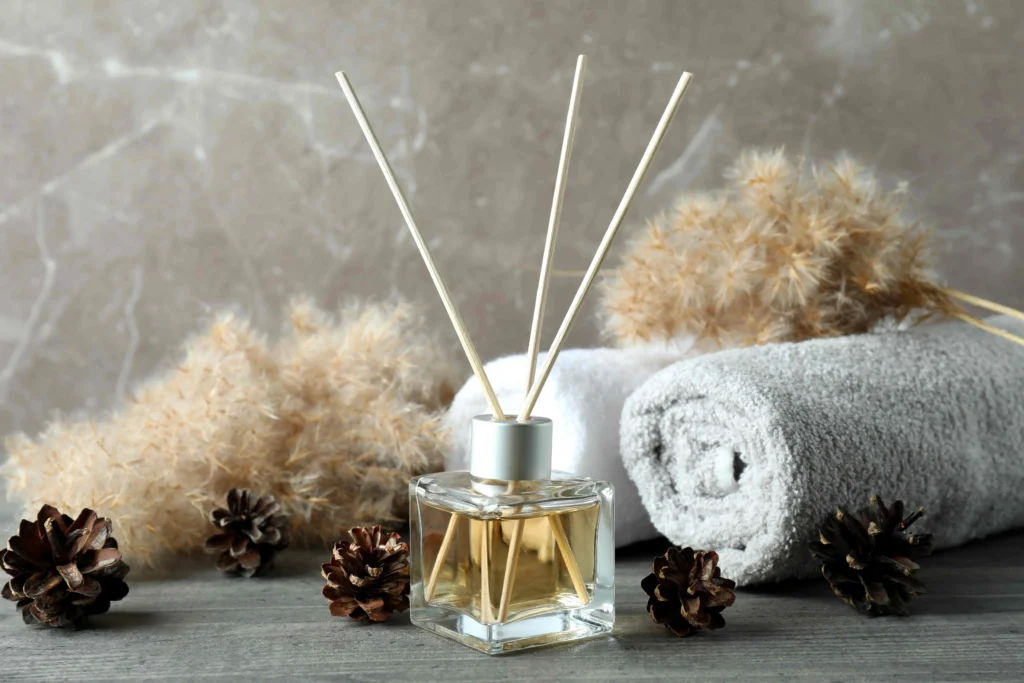
How Reed Diffusers Work and What Affects Performance
A reed diffuser works by allowing reeds to absorb fragrance oil and release it into the air through evaporation.
The overall performance depends on the oil formulation, the type of reeds, and the surrounding environment.
Placement plays an important role. Diffusers perform better in areas with light air circulation, such as hallways or living rooms, where the scent can spread more evenly. Direct sunlight or heat should be avoided, as it can cause the oil to evaporate too quickly.
The number of reeds also affects the result. Using more reeds creates a stronger scent but shortens the product lifespan, while fewer reeds produce a lighter scent and last longer.
Reed type makes a difference as well. Rattan reeds are commonly used, while fiber reeds tend to provide more consistent diffusion depending on the formulation.
Usage Tips for Better Results
To maintain scent performance, reeds can be flipped occasionally to refresh the fragrance. However, frequent flipping will increase evaporation and reduce how long the diffuser lasts.
Reeds should not be reused when changing fragrance oils, as they may carry residue that affects the new scent.
It is also important to understand that there is always a balance between scent strength and longevity. Stronger diffusion usually results in faster oil consumption, while longer-lasting products tend to have a more subtle scent.
Conclusion
Reed diffusers are straightforward to use, but small details such as placement, reed selection, and usage habits can significantly affect their performance.